


When you are shopping for a rug, “handmade” can cover a surprisingly wide range of rug construction methods. Two rugs may both be made from the same material, have a similar pile, and look almost identical in a photograph, yet differ significantly in price.
Hand-knotted rugs are built by tying the pile into the foundation one knot at a time, while hand-tufted rugs are made by inserting yarn through a foundation and securing it with a backing.
The construction method affects how the rug wears, how much it sheds, how it should be cleaned, whether the backing can deteriorate over time, and how realistic it is to expect the rug to last for decades.
In this guide, we’ll look closely at hand-knotted and hand-tufted rugs, including how each is made, what you are actually paying for, how they compare in durability and care, and when spending more on a hand-knotted rug is or is not worth it.
What Is a Hand-Knotted Rug?
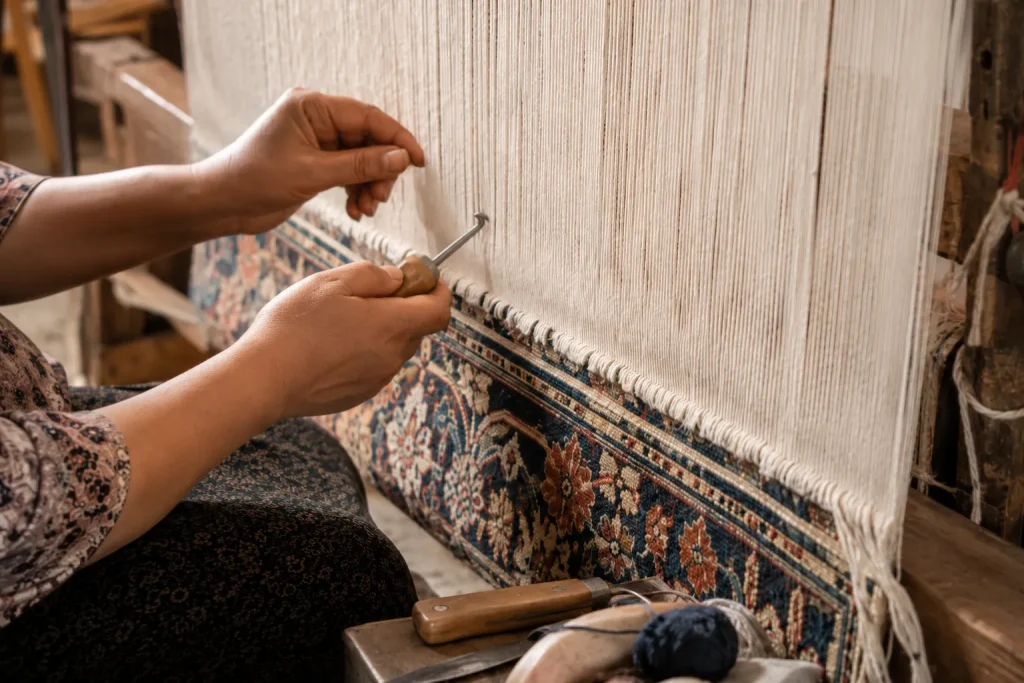
A hand-knotted rug is made on a loom with vertical warp threads forming the foundation of the rug. The weaver ties individual pieces of yarn around those threads, working row by row until the pattern and pile are built across the entire rug.
Each knot becomes part of the rug’s structure rather than simply sitting on top of a separate backing.
Depending on the size and complexity of the design, a hand-knotted rug can contain hundreds of thousands or even more than a million individual knots.
Once the weaving is complete, the rug still needs to be washed, stretched, clipped, detailed, and finished before it is ready to use.
The process can take several months. Larger rugs, denser knotting, more complicated patterns, and finer materials can all extend the production time considerably.
That amount of skilled labor is the main reason hand-knotted rugs usually cost significantly more than hand-tufted rugs.
Durability and Lifespan
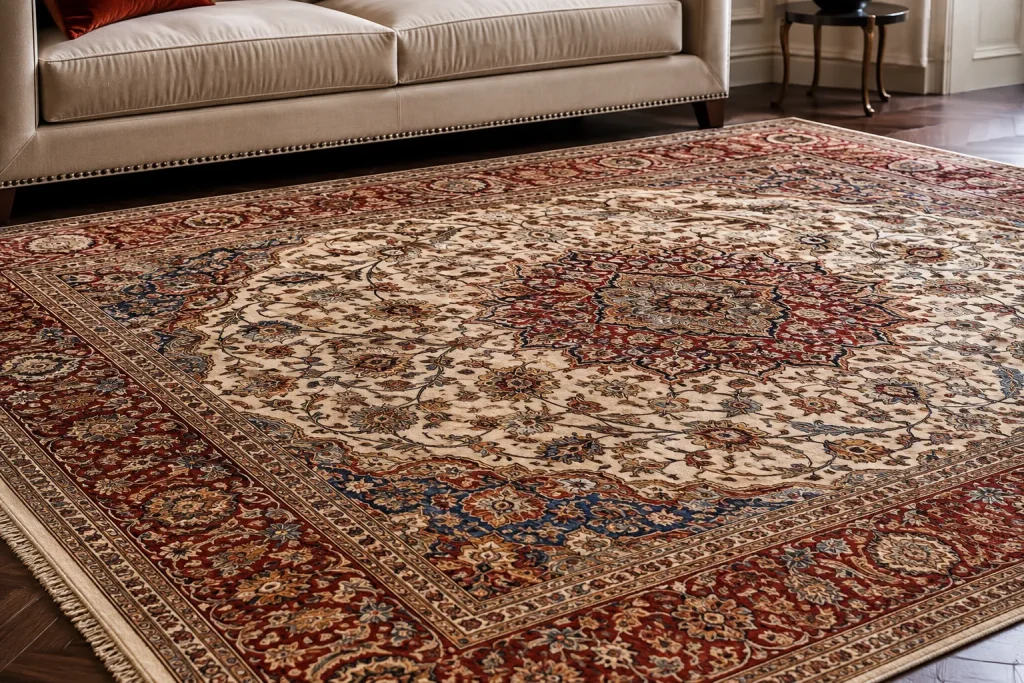
Durability is one of the strongest reasons to choose a hand-knotted rug.
Because every section of pile is tied into the woven foundation, the rug does not depend on an adhesive layer to hold the surface together. When the materials and workmanship are good, that creates a structure capable of handling years of regular use.
A well-made hand-knotted rug can last for decades. Antique Persian, Turkish, and other hand-knotted rugs have also survived for generations, though that doesn’t mean every new hand-knotted rug will automatically last 50 or 100 years.
How long any rug lasts still depends on the quality of the wool or other fiber, how tightly and consistently it was woven, where it is used, how much foot traffic it receives, and how it is cleaned and maintained.
A hand-knotted rug in a busy living room may show wear sooner than the same rug used in a bedroom, but its construction generally gives it a much longer potential lifespan than a tufted rug of comparable quality.
This is also why hand-knotted rugs are often used in rooms where the rug is expected to stay through several furniture changes rather than being replaced every few years.
Price
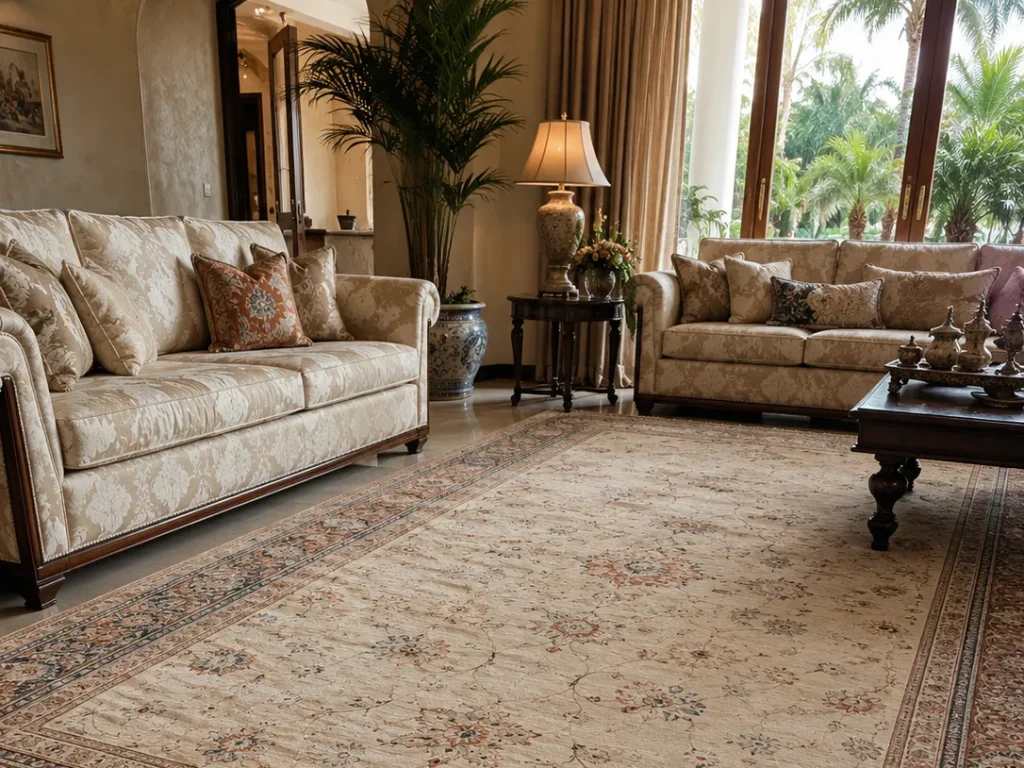
The higher price of a hand-knotted rug comes largely from labor.
The weaver creates the surface one knot at a time, and increasing a rug’s size, density, or complexity adds substantially more work.
For an 8′ x 10′ rug, hand-knotted options commonly begin somewhere around $1,300 to $3,000, while higher-end examples can cost $5,000, $10,000, or considerably more.
No single price defines a good hand-knotted rug. The final cost can change based on:
- the size of the rug
- the material used
- knot density
- complexity of the pattern
- number of colors
- where the rug is made
- finishing
- customization
Knot density is often expressed as knots per square inch, or KPSI. A denser rug allows finer curves, smaller motifs, and more intricate details, and it generally requires more labor.
But a higher knot count does not automatically make a better rug.
Some Oushak and other traditionally woven rugs intentionally use a more open weave and are valued for their wool, dyes, proportions, and design rather than an exceptionally high knot count.
A rug with excellent wool and skilled weaving can be better made than a much denser rug produced with brittle fibers or poor finishing.
KPSI is useful information – we treat it as one specification rather than a universal quality score.
Shedding
A new hand-knotted wool rug can shed, especially during the first few months of use.
Some loose fibers are left behind during clipping and finishing, and regular vacuuming helps remove them. With good wool, shedding generally becomes less noticeable over time.
The quality of the wool makes a large difference here.
Longer, stronger fibers tend to stay together better than short, brittle fibers. A rug made from lower-quality wool can continue releasing fibers even if the rug itself is hand-knotted.
This is why the phrase “100% wool” only tells you part of what you need to know. It describes the material, but it says nothing about the wool grade or how the rug was made.
A hand-knotted construction and a high-quality wool pile are two separate things, and ideally you want both.
Cleaning and Care
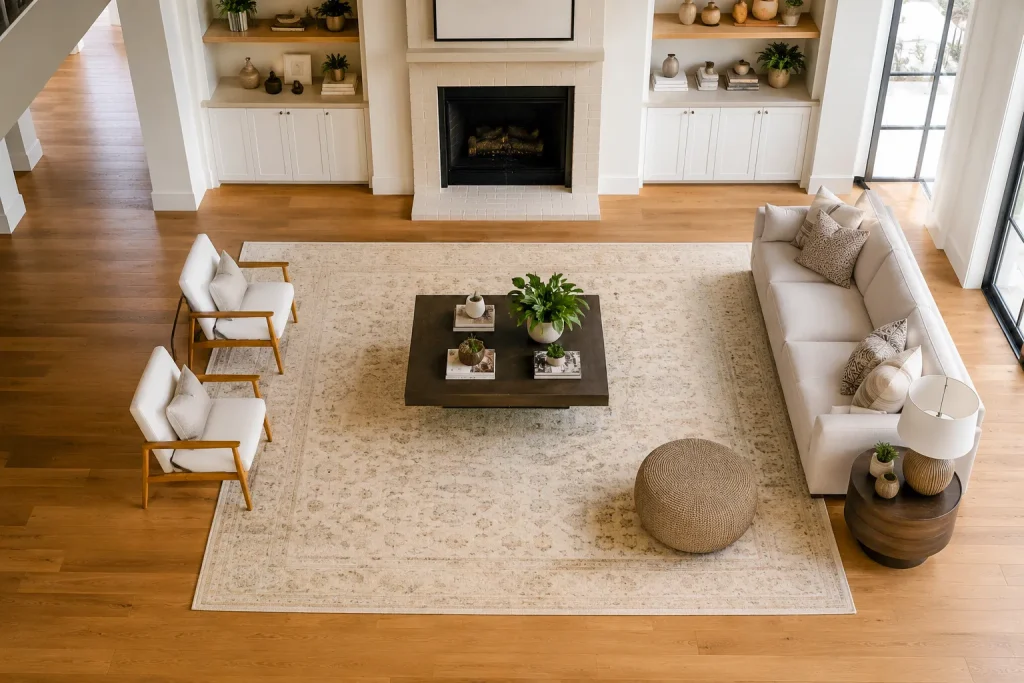
Hand-knotted rugs are generally straightforward to maintain with regular vacuuming, occasional rotation, and prompt spill treatment.
They should still be cleaned according to the fiber and dyes used in the rug. A wool rug and a wool-and-silk rug, for example, may need different treatment even though both are hand-knotted.
Depending on the materials and dyes, many hand-knotted wool rugs can also be professionally washed much more thoroughly than a tufted rug because they don’t have an adhesive backing that needs to remain stable.
That does not mean you can saturate the rug or clean it carelessly at home.
Excess water, harsh chemicals, aggressive scrubbing, or improper drying can still damage fibers, cause dyes to bleed, affect the fringe, or distort the foundation.
For a valuable rug, especially one containing silk or delicate fibers, professional rug cleaning is usually the safer option.
Repairability
Hand-knotted rugs are also more repairable than most other rug constructions.
Because the foundation and pile are woven together, a skilled rug restorer may be able to repair damaged fringe, rebuild an edge, reconstruct parts of the foundation, or replace missing knots in worn areas.
Whether a repair makes financial sense depends on the rug.
A large restoration may cost more than replacing an inexpensive rug, while a custom, antique, high-value, or sentimental rug may be worth repairing several times during its life.
The important difference is that the construction itself usually makes meaningful restoration possible.
How to Tell If a Rug Is Hand-Knotted
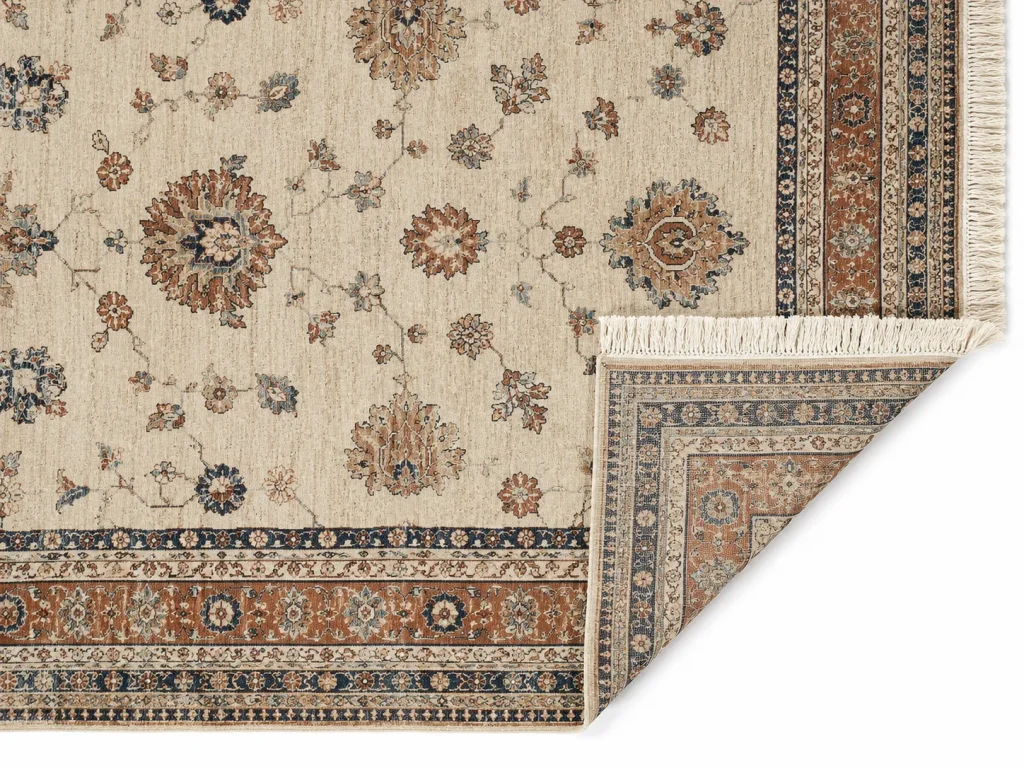
The easiest way to identify a hand-knotted rug is to turn it over.
You should normally be able to see the design from the back because you are looking at the same woven structure that forms the front of the rug. The colors will appear flatter and the pile will not be visible, but the pattern should still be recognizable.
You may also see small variations in the knots and weave. Handmade does not mean every knot will be perfectly identical.
If the rug has fringe, it can offer another clue. On many traditional hand-knotted rugs, the fringe is formed by the warp threads that run through the rug itself rather than being sewn onto the finished edge.
If you are buying online and the retailer does not show the reverse of the rug, ask for a photograph. The back can often tell you more about the construction than another styled photograph of the front.
What Is a Hand-Tufted Rug?
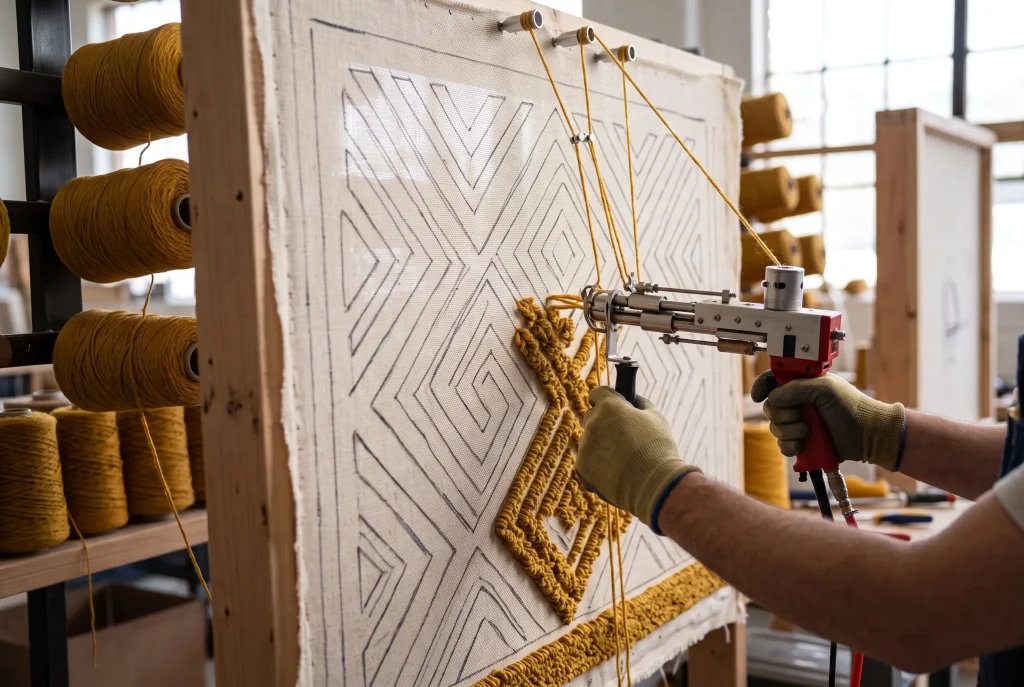
A hand-tufted rug starts with a fabric foundation stretched over a frame. The design is transferred to the surface, and a maker uses a hand-operated tufting tool to push yarn through the foundation.
The yarn is not tied around the foundation in individual knots.
Once the design has been tufted, adhesive is applied to the reverse to help secure the yarn. A secondary cloth backing, sometimes called a scrim, is then bonded over it to cover and protect the construction.
The pile can then be clipped, carved, or finished to create the intended texture and pattern.
Hand-tufted rugs are still handmade. A person guides the tufting tool and follows the design rather than the rug being produced automatically on a power loom.
The difference is how the yarn becomes part of the rug.
Because the maker does not need to tie every individual knot, a hand-tufted rug can usually be produced in days or weeks rather than the several months often required for hand-knotting.
Durability and Lifespan
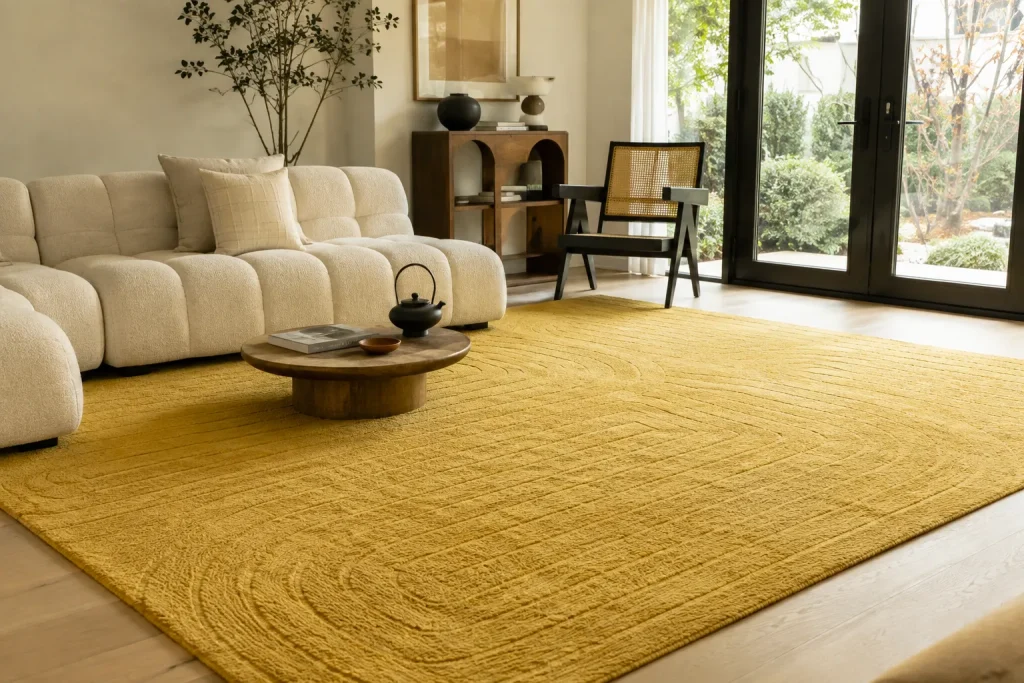
A good hand-tufted rug can last for years, but it generally does not have the same lifespan as a comparable hand-knotted rug.
Published estimates vary considerably, with many placing hand-tufted rugs somewhere around 5 to 20 years of use. We would treat those figures as general guidelines rather than a lifespan you can expect from every rug.
A lightly used hand-tufted rug in a guest bedroom may stay in very good condition for much longer than one placed in a busy family room.
The material, tuft density, backing, adhesive, foot traffic, pets, moisture, and cleaning all affect how quickly the rug wears.
The main structural difference is the backing.
Because the pile isn’t individually knotted into the foundation, hand-tufted rugs generally rely on adhesive to keep the tufts secure. That adds another component to the rug that has to remain stable as it ages.
Over time, some adhesives can become brittle and begin breaking down. One of the first signs may be a fine white or yellowish powder, or a sand-like material, collecting on the floor underneath the rug.
That material does not necessarily mean the wool itself is falling apart. It can be the adhesive or other backing material deteriorating.
In more advanced cases, the secondary fabric backing can begin separating from the rug, a problem known as delamination.
Moisture can complicate backing problems, particularly if the rug becomes repeatedly wet or does not dry properly.
Backing can also cause odor in some hand-tufted rugs. A strong rubbery or chemical smell that persists well beyond unpacking may be coming from the adhesive rather than the wool itself.
None of these problems are guaranteed to happen simply because a rug is hand-tufted.
The quality of the adhesive, backing, wool, and overall construction can make a considerable difference in how the rug ages. This means a tufted rug has additional materials that can eventually become a point of failure.
Price
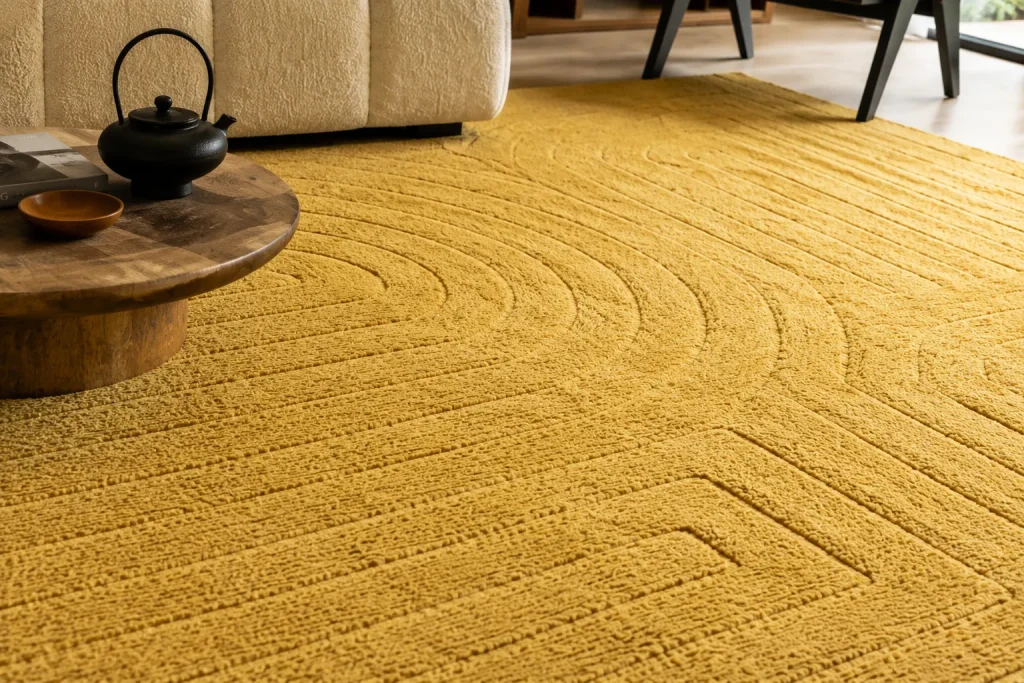
The main advantage of hand-tufting is that it allows a handmade rug to be produced much faster.
The maker does not have to tie every individual knot, so a complicated design can be completed with far fewer hours of labor.
For an 8′ x 10′ wool rug, hand-tufted options often fall somewhere around $400 to $1,500, although premium and custom rugs can cost considerably more.
A hand-tufted rug made from high-quality wool can cost more than a basic hand-knotted rug. Large custom sizes, sculpted pile, unusual shapes, and detailed patterns can also push the price higher.
This is another reason price alone is not a reliable way to identify how a rug was made.
Shedding
Shedding comes up more often with hand-tufted wool rugs than with hand-knotted rugs, although the construction is not the only factor.
Some initial shedding is normal with any new wool rug. Loose fibers created during manufacturing and finishing need time to work their way out of the pile.
With hand-tufted rugs, shedding can sometimes continue for longer because of how the yarn is cut and inserted into the foundation.
Shorter or weaker fibers break away more easily and can create a rug that continues filling the vacuum or leaving fibers on clothing long after the initial break-in period.
A high-quality hand-tufted wool rug may shed very little after the first several months, while a poorly made one may continue shedding throughout much of its life.
We would therefore look at fiber quality and construction together rather than assuming that every tufted rug will shed heavily.
If a rug continues losing substantial amounts of fiber long after normal initial shedding should have settled, we would not automatically accept that as normal simply because the rug is wool.
Cleaning and Care
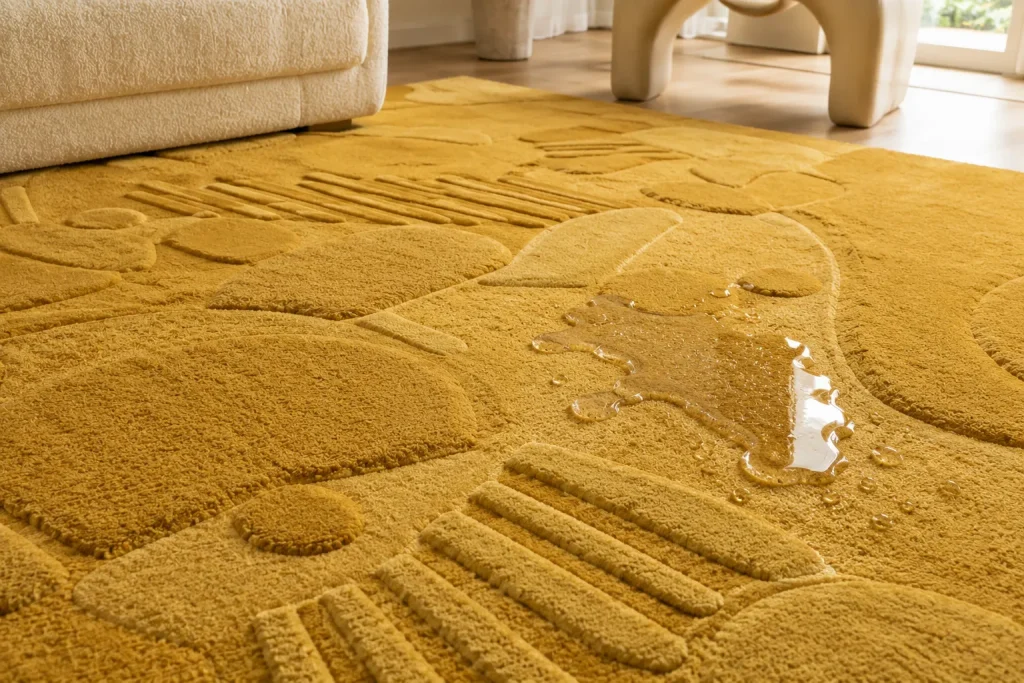
Hand-tufted rugs need more caution when it comes to deep cleaning because of their layered construction.
A spill that stays near the surface can usually be treated without much difficulty. Problems are more likely when liquid travels through the pile and reaches the adhesive and backing underneath.
A hand-tufted rug generally should not be saturated during cleaning.
Too much water can affect the adhesive, while the canvas, adhesive, and secondary backing can take considerably longer to dry completely than the visible surface of the rug.
This is particularly relevant with pet urine. Once liquid reaches the backing layers, odor can become much more difficult to remove because the problem is no longer limited to the pile.
Repeated saturation may also contribute to adhesive deterioration or delamination over time.
For that reason, we recommend avoiding a household carpet-cleaning machine that thoroughly soaks a hand-tufted rug. For major spills or a full cleaning, a professional cleaner who understands tufted rug construction is usually the better option.
Regular vacuuming, rotation, and quick spill cleanup can go a long way toward keeping the rug in good condition.
Repairability
Hand-tufted rugs can sometimes be repaired, particularly when damage is limited to a small area of the pile.
Larger structural problems are more difficult.
If the backing has started separating or the adhesive is deteriorating across a large section of the rug, repairing it may not be practical or economical.
Replacing the backing does not necessarily reverse problems occurring within the adhesive underneath it.
This is one of the biggest differences from hand-knotted construction, where an experienced restorer can often rebuild sections of the woven structure.
How to Tell If a Rug Is Hand-Tufted
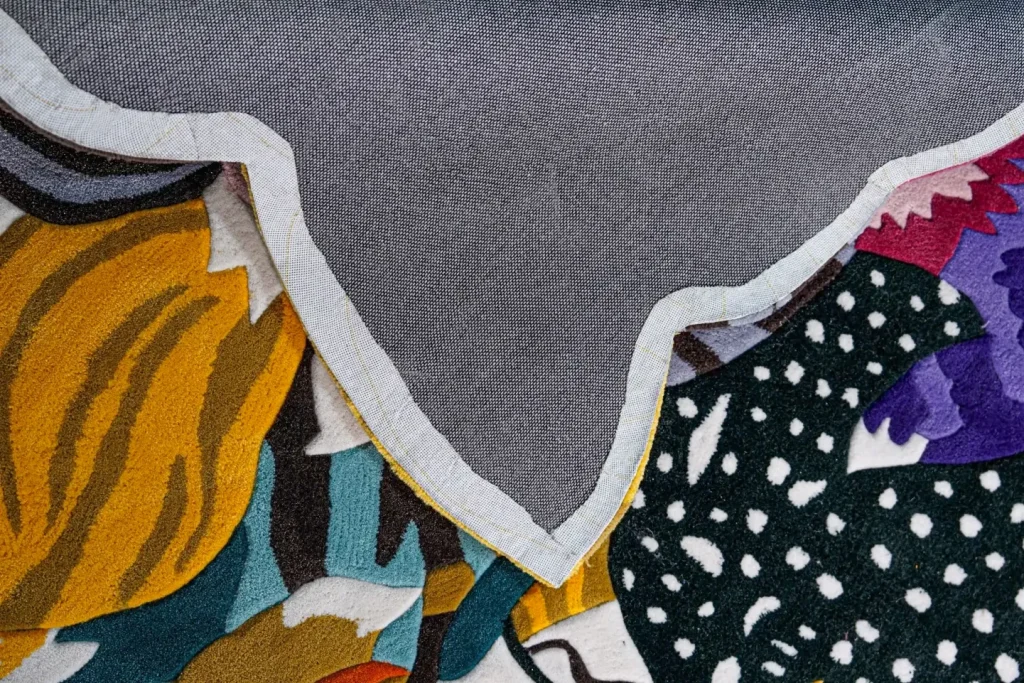
Turn the rug over.
Most hand-tufted rugs have a secondary fabric backing covering the underside. Instead of seeing the woven pattern from the front of the rug, you will usually see a solid piece of cloth.
If the rug has fringe, it may also be attached after the rug has been made rather than forming part of the structural foundation.
Hand-tufted rugs are often thick and plush, but thickness should only be treated as a clue. Some hand-knotted rugs have a deep pile, and some hand-tufted rugs are relatively thin.
If a product description only says “handmade,” “handcrafted,” or even “100% wool,” look for the actual construction method before assuming what you are buying.
Hand-Knotted vs. Hand-Tufted Rugs: Which Should You Choose?
If durability is the main priority, hand-knotted is the stronger construction. That does not mean it is automatically the right purchase for every room.
The better choice depends on how long you expect to keep the rug, where you plan to use it, what you want to spend, and what you expect from the design.
Choose a Hand-Knotted Rug If You Want to Keep It for the Long Term
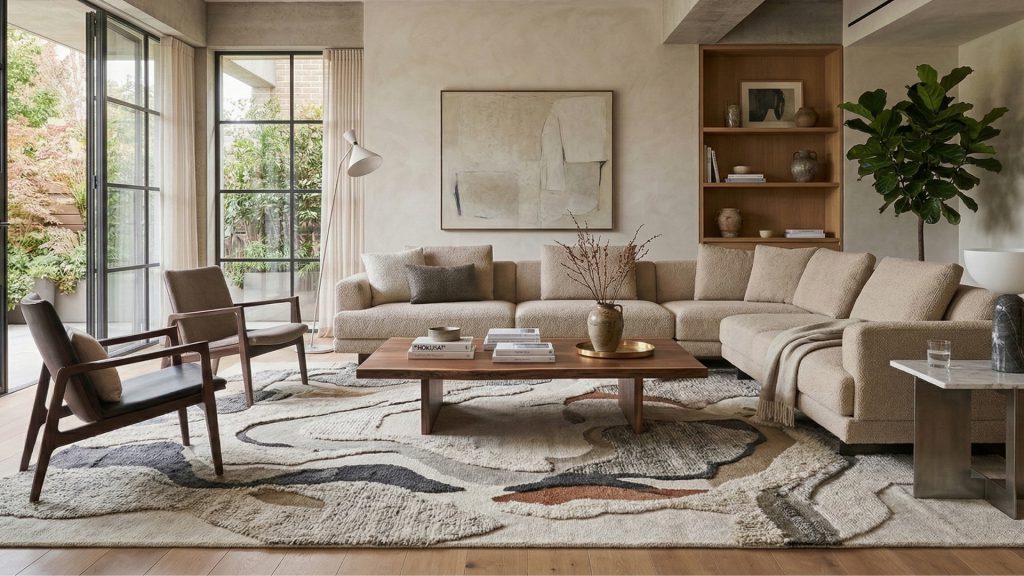
We generally lean toward hand-knotted construction when the rug is going into a main living space, and you expect it to stay there for many years.
It makes particular sense when:
- the rug will receive regular foot traffic
- you want to keep it through several furniture changes
- repairability is important
- you are commissioning a custom piece for a long-term home
- you value the weaving and craftsmanship itself
- you are comfortable spending more upfront for longer potential use
For a custom rug designed specifically around a room, the additional cost can be easier to justify because the goal is usually not to replace it the next time the furniture changes.
The higher price can also look different when spread over a much longer period of ownership.
Choose a Hand-Tufted Rug If You Want More Flexibility at a Lower Price
Hand-tufted construction makes a lot of sense when longevity is not the only priority.
It can be a particularly good option when:
- you have a more defined budget
- the rug is going into a bedroom or lower-traffic space
- you like changing your interiors regularly
- you want a thick, plush surface
- the design uses carved or sculptural pile
- you need a very large rug without the cost of hand knotting
- you do not expect the rug to remain in the home for several decades
Spending more for decades of potential durability does not make much sense if you already know you will want a different rug in five or ten years.
On the other hand, if you are designing a room around a rug that you expect to keep through several sofas, chairs, and other changes, the additional cost of hand-knotting becomes much easier to justify.
Does Hand-Knotted Always Mean a Better Rug?
Hand-knotted is the stronger construction, but the words alone do not guarantee that you are looking at a high-quality rug.
You still need to consider several factors, including:
- the quality of the wool, silk, or other fiber
- the consistency of the weaving
- the quality of the dyes
- the finishing
- the foundation
- the complexity and execution of the design
- the overall workmanship
The same applies to hand-tufted rugs.
A well-made hand-tufted rug using excellent wool and a good backing can be a much better product than a poorly executed tufted rug made with brittle fibers and low-quality adhesive.
A hand-tufted rug can also use better wool than a lower-quality hand-knotted rug.
Choosing a Custom Hand-Knotted or Hand-Tufted Rug

Custom rugs are usually more useful for most homes because you are not limited to whatever combination of size, color, material, and construction happens to be available in a showroom.
You can choose the construction based on how the rug will actually be used.
For a living room, dining room, or other long-term space where durability is a priority, hand-knotting may justify the additional cost and production time.
Hand-tufting can be a better fit when the design calls for a very thick pile, carved details, unusual shapes, or a large custom size where hand-knotting would push the project well beyond the intended budget.
Not every custom rug needs to be constructed the same way. At Adorn Croft, we can develop the size, shape, material, colors, pile, and construction around the room itself.
We choose the method that makes sense for how you want the rug to look, feel, and wear, rather than simply choosing whichever construction costs more.
We help turn your ideas into a rug you can see and feel confident about.
Book a Free Design CallAuthor bio

Beautiful homes start with great ideas.
Get curated ideas on materials, finishes, and styles for your home